
Employer partnerships · Apprenticeships
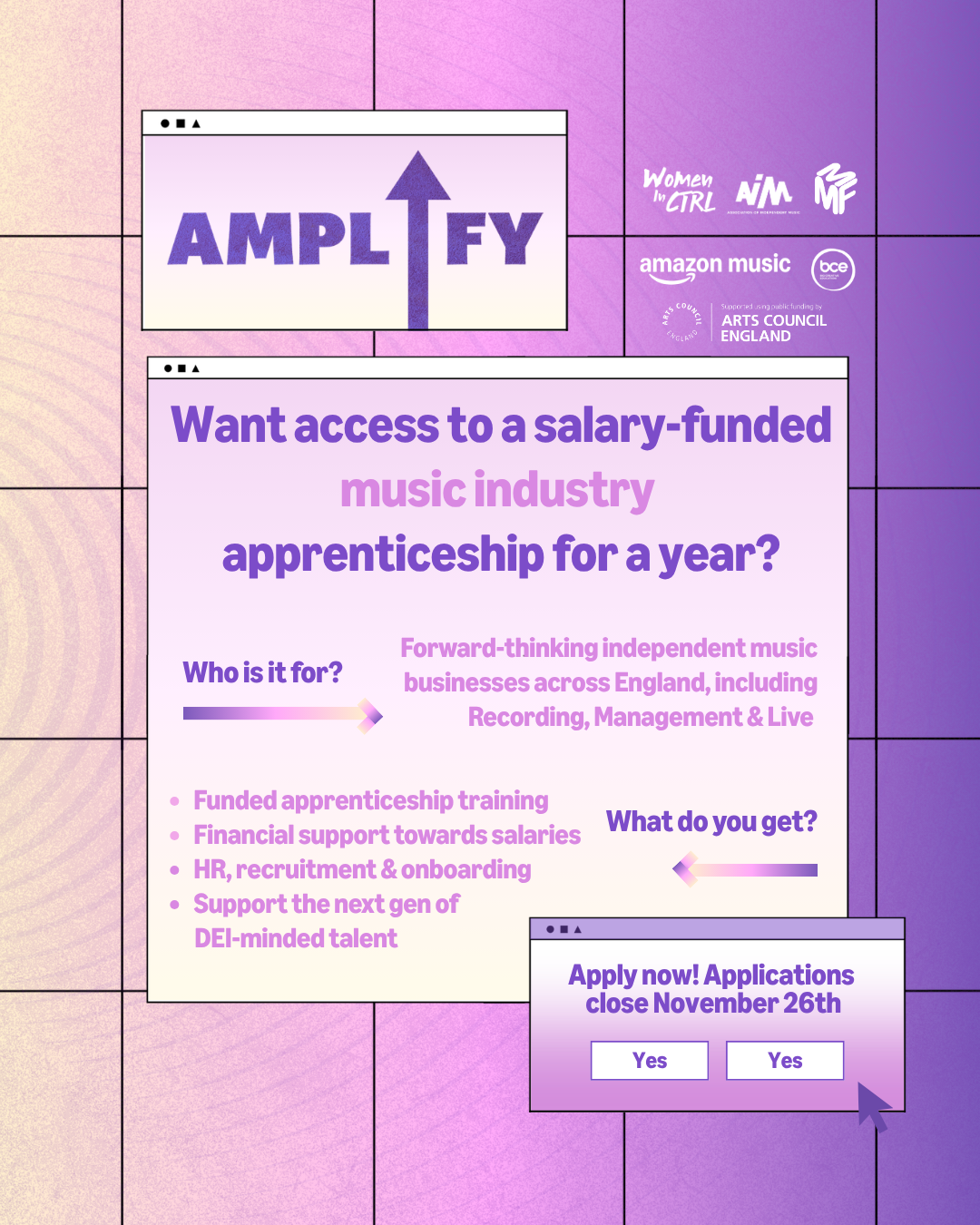
Want access to a salary-funded music apprenticeship for a year?
We're proud to be the training provider behind Amplify: up to six independent music businesses will receive a salary-funded apprentice, full training and wraparound support for 12 months. Here's what's on offer, who it's for, and how to apply.
Are you an independent music business ready to build a more inclusive, innovative and future-proof team? We're officially opening applications for the Amplify 27/28 cohort, and we're looking for forward-thinking independent music businesses across the industry in England, including recording, management and live.
What is Amplify?
Amplify creates paid, accredited apprenticeship pathways into the music industry for young (18–25) women and people of marginalised genders facing structural barriers into paid music industry roles.
For the 2027/28 cohort, six or more independent music businesses based in England will be selected to receive financial support covering up to 25%* of the apprentice's salary over a 12-month contract. Eligible businesses can also apply to Round 3 of the Music Growth Fund for another source of salary support — see our FAQs or get in touch for details. Each participating employer is matched with one apprentice, filling an entry-level position focused on administrative support and operational assistance. Employers also receive wraparound support — recruitment, onboarding and HR support — while apprentices train with Big Creative Education towards a Level 3 accredited qualification.
*Training is fully funded through Amazon Music's apprenticeship levy. Amplify contributes up to 25% of the apprentice's 12-month salary to a selection of six or more successful applicants. Salaries are based on the Real Living Wage. Employers remain responsible for NI and pension.
Why does Amplify exist?
Access to the music industry is narrowing, not widening. Unpaid entry routes are a big reason: most arts internships are unpaid, shutting out anyone who can't afford to work for free. Those barriers fall hardest on women and people of marginalised genders.
- 19% — working-class representation across UK creative industries, down from 26% in 2020
- 86% — of arts internships are unpaid (Sutton Trust)
- 19% — of musicians earning £70,000+ are women (2024 Musicians' Census Women's Insight Report)
The same report, co-produced by Women in CTRL, found that 51% of women had experienced gender discrimination at work, and a third had been sexually harassed while working. Amplify exists to remove the resource barrier that stops businesses from opening these doors — funding paid apprenticeships and wraparound support so the next generation can get in on talent, not connections.
The business benefits
- Salary supportUp to a 25% salary contribution towards staffing costs for your assigned apprentice.
- Additional apprenticeship grantsGrants of up to £6,000 for new hires may also be available, subject to eligibility criteria.
- Apprentice trainingAmazon Music covers the full cost of training through its apprenticeship levy, at no cost to you.
- HR supportA funded HR support package for your apprentice's employment.
- Wraparound supportRegular check-ins for your apprentice, supporting your team throughout the programme.
- Access to diverse talentTap into overlooked talent pools: passionate 18–25 year olds eager to grow in the independent sector.
- Structured supportYou don't do it alone: hands-on recruitment support, guidance and apprentice check-ins throughout.
- Industry visibilityShow your commitment to a more equitable industry, and join a network of businesses championing change.
- Future-ready teamsDEI-minded talent brings fresh perspectives that contribute directly to your business growth.
Find out more about what an apprenticeship levy is here.
Is your business eligible?
We welcome applications from any independent music business across England, including recording, management and live. For this round, applications are open to everyone — you don't need to be a member of AIM or MMF to apply, though your membership body may be able to help if you are.
The apprentice must spend at least half their working hours in England, so your business needs a base or regular presence there, though you can be based anywhere in the UK. If you're committed to inclusive practice and can provide a dedicated line manager to support an apprentice for 12 months, we want to hear from you.
Key dates
- — Amplify employer applications open.
- — Employer webinar: an information overview on applying to the programme, plus Q&A. Sign up to the webinar.
- — Amplify employer applications close.
- — You'll hear back on the success of your application.
Apprentice recruitment opens in the new year, with selected apprentices in post by mid-May 2027 on a 12-month employment contract and training programme.
Join the movement to make our music sector more representative and resilient.
Put your business forward as an Amplify employer. Applications close at 11:59pm on Thursday 26 November 2026.
Apply hereAmplify 27/28 frequently asked questions
Amplify exists to reduce barriers to entry into the UK music industry by creating paid, accredited apprenticeship roles that develop a new generation of DEI industry professionals, while strengthening independent businesses across the ecosystem. The scheme supports young people aged 18 to 25 facing structural barriers into paid music industry roles, with a particular focus on women and people of marginalised genders. The programme aims to increase the representation of these groups across the independent music sector, and to build a workforce that treats diversity, equity and inclusion (DEI) as core drivers of innovation and long-term success.
Amplify will support six or more independent music businesses, based in England, to hire an apprentice for 12 months, with up to 25%* contribution towards an apprentice's salary. Eligible businesses can also apply to the Music Growth Fund Round 3 for another source of salary support (read more in question 9 below).
The apprentice's training is fully funded through Amazon Music's apprenticeship levy at no cost to the employer, and every business receives wraparound support including apprentice recruitment, an HR service package, onboarding support and ongoing check-ins.
*Employers remain responsible for employer NI and pension. Our definition of woman or women is trans-inclusive and includes anyone who self-identifies as a woman.
Select a question to open the answer.
1. What is the Amplify Apprenticeship Scheme?
Many music businesses are focused on improving diversity and inclusion in the independent music sector and in particular improving representation of women and people of marginalised genders in music. Amplify is co-founded by Women in CTRL and Amazon Music, in partnership with Big Creative Education, AIM and MMF, who have come together to support this work and accelerate change. Amplify is supported by Arts Council England via AIM.
This scheme was developed to enable six music businesses (three of which will be based outside of London) to hire an apprentice for 12 months.
Amplify's core ambition is to cultivate a new generation of industry talent, embedding diversity, equity, and inclusion (DEI) as fundamental drivers of innovation and long-term sector success. Participating companies benefit from financial resources, enhanced visibility within the music industry, and access to an influential network committed to sector-wide advancement. A more inclusive music industry creates the foundation for a more diverse and vibrant music scene.
Participating employers will receive wraparound support, including recruitment, onboarding and HR support. Apprentices will receive structured training from Big Creative Education, coming away with a Level 3 accredited qualification.
Our key objectives
Broaden access to the industry. Directly support career pathways into employment by creating paid, accredited entry routes for young people aged 18 to 25 facing socio-economic and structural or systemic barriers, ensuring opportunities are accessible to all, including those who have not entered through higher education. This scalable model aims to dismantle historic barriers and establish equitable, inclusive recruitment as the industry standard.
Develop DEI-minded talent. Equip apprentices with the industry skills, confidence, and professional networks required for lasting careers, fostering an inclusive approach that permeates their future practice.
Support SME growth. Empower independent music businesses across labels, management, publishing, sync, and live sectors to recruit and nurture diverse new talent, helping them build inclusive, innovative teams that contribute to business growth.
Drive systemic change. Establish a sustainable, repeatable youth-to-workforce pathway that promotes long-term systemic change, keeping gender diversity central within a broader, intersectional access and inclusion mandate. This approach empowers participating businesses to cultivate inclusive, innovative teams, driving both commercial growth and sustainable sector improvement.
Foster inclusive leadership. Champion a new generation of professionals who view diversity, equity, and inclusion not as peripheral concerns, but as essential values for the industry's ongoing health, innovation, and relevance.
Strengthen employer resources and networks. Offer participating businesses financial support, greater industry visibility, and access to a connected network committed to sector-wide advancement.
2. Recent data on why this scheme is needed
Amplify was co-founded by Women in CTRL and Amazon Music in response to a growing body of evidence on the barriers facing young women, people of marginalised genders and those from underrepresented backgrounds in the independent music industry.
Access to the industry is narrowing, not widening. Working-class representation across the UK creative industries fell from 26% in 2020 to 19% in 2023 (DCMS). The UK Music Diversity Report 2024 found 56.1% of the music workforce came from professional backgrounds, against just 20.9% from working-class backgrounds. Unpaid entry routes are a large part of why: a Sutton Trust study found 86% of arts internships were unpaid, shutting out anyone who cannot afford to work for free.
These barriers fall hardest on women and people of marginalised genders. The 2024 Help Musicians' Census Women's Insight Report, co-produced by Women in CTRL, found women make up only 19% of musicians earning £70,000 or more, that 51% of women had experienced gender discrimination at work (against 6% of men), and that a third had been sexually harassed while working. On the creative side, only 19% of artists signed to UK label rosters in 2019 were women (Vick Bain, Counting the Music Industry).
Small and medium-sized music businesses often cannot take on apprentices, because they lack the resources to cover both training and salary. Amplify was built to remove that barrier, offering paid apprenticeships, practical business support and structured career pathways for the next generation of music professionals.
3. What is the difference between an apprentice and an intern?
Apprenticeships are a fantastic opportunity for a label to attract this talent and diversify their workforce. They allow companies to tap into overlooked talent pools while contributing to a more inclusive future for the sector.
Apprenticeships vs internships: what's the difference?
Internships are short-term opportunities (often for students or recent graduates) to gain general workplace experience.
Apprenticeships are structured training programmes for a specific job, combining:
- On-the-job training
- Off-the-job learning
- A formal qualification at the end
Apprenticeships can last from 1 to several years, depending on the role and industry. Both internships and apprenticeships are paid.
Our goal is for apprentices to be retained by their host company, but it's up to the apprentice and business to decide what happens after the programme ends. For more details, see the Institute for Apprenticeships & Technical Education (IfATE) guide.
4. What makes a business eligible to apply?
We welcome applications from all forward-thinking independent music businesses across England, including recording, management and live, who can host a paid apprentice for 12 months.
To be eligible, businesses must:
- Have a genuine commitment to increasing the representation of women, people of marginalised genders and other underrepresented people, both in their own teams and in the talent they work with.
- Be able to offer a meaningful experience with clear day-to-day support.
- Provide a dedicated line manager with a proven track record of effectively developing and supporting others, not just managing people.
- Foster an inclusive culture where all members of the team feel seen, heard, and valued.
- Employ the apprentice directly on a 12-month fixed-term contract. The apprenticeship programme runs for 12 months, which covers the full planned duration of the programme, including the End Point Assessment (EPA) period.
- Be in a financially stable position with a realistic plan to support a 12-month apprenticeship. Businesses of any size, genre, or stage of development are encouraged to apply, and we don't require a long trading history.
- Be independent. "Independent" means no more than 49% of the business is owned by a major music company (Warner Music, Sony Music or Universal Music, or any of their affiliates or subsidiaries).
- Have a base or regular working presence in England where the apprentice will be located. Your business can be UK-based, but the apprentice must spend at least 50% of their working hours in England over the apprenticeship.
Our ideal outcome is that apprentices are retained by their host company, but that decision rests with the business and the apprentice.
Where possible, we recommend employers consider a 13-month fixed-term contract. This provides a small amount of additional flexibility should an apprentice require extra time to complete their EPA or experience a late completion.
The expectation is that apprentices remain on track and proactively work towards completing within the planned 12-month programme. Late completions are uncommon, but the additional month provides a helpful safety net and reduces the risk of employment ending before the apprenticeship is fully completed.
5. What is the selection process for businesses?
(See question 16 for key dates.)
We want to make joining the programme as clear and supportive as possible. Here is what you can expect as we review applications and select our six host employers:
Stage 1: Alignment and readiness review. We review applications to celebrate what makes a great host partner. We look for stable organisations with supportive line management and a strong, genuine commitment to empowering women and people of marginalised genders in music.
Stage 2: Building a balanced cohort. To foster rich collaboration and broad impact, we seek to bring together diverse voices across different music sectors, company sizes, and geographic regions, with a commitment to hosting at least 3 of the 6 roles outside of London.
Stage 3: Interactive panel and dialogue. Shortlisted employers are invited to an open, conversational interview. This is an opportunity to discuss your vision for the placement, ask questions, and ensure a strong mutual fit.
We expect there to be many more applications than available spaces. We hope to grow the scheme, giving the opportunity to more businesses to take on apprentices. Businesses whose applications do not meet the criteria will be informed and are welcome to reapply if the programme is repeated.
6. How can my business apply?
If you would like to apply, please complete the application form here.
Women in CTRL, AIM, Big Creative Education and Amazon Music will host an online information session about the scheme on Thursday 29 October 2026. To find out more and ask any questions before applying, sign up here.
7. How much does it cost for a business to hire an Amplify apprentice?
Apprentices work a 37.5-hour week and are paid at least the Living Wage: the London Living Wage for London roles and the Real Living Wage for roles elsewhere. Based on May 2026 rates, with an example of a 25% salary contribution from Amplify:
| London | UK (outside London) | |
|---|---|---|
| Hourly wage | £14.80 (London Living Wage) | £13.45 (Real Living Wage) |
| Base salary (12 months, 37.5 hrs) | £28,860 | £26,227.50 |
| Amplify contribution (25% of base) | £7,215 | £6,556.88 |
| Employer pays (remaining 75% of base, plus employer NI and pension) | £21,645 + on-costs | £19,670.63 + on-costs |
Rates shown are May 2026 rates. Employer on-costs (NI and pension contributions and holiday pay) vary with the apprentice's age and your pension scheme. For apprentices under 25, employers are generally exempt from employer National Insurance on earnings below the relevant threshold, which reduces the on-cost.
Amazon Music funds the full cost of the apprentice's training through its apprenticeship levy, at no cost to the employer. Amazon Music also funds a salary contribution of up to 25% of each apprentice's base salary, administered and paid to employers by AIM.
The businesses will need to pay the remaining salary, plus all employer NI and pension contributions (where applicable). Member businesses must demonstrate their commitment to the scheme, as well as contribute their knowledge and time to support the apprentices.
8. Funding and financial support
Through Amplify, Amazon Music funds the full cost of the apprentice's training via its apprenticeship levy and will offer six or more music businesses up to a 25% salary contribution for an apprentice starting in an entry-level co-ordinator role.
That gives every selected business fully funded training and up to 25% of the base salary covered.
Find out more about what an apprenticeship levy is here.
9. Additional funding
Eligible businesses can also apply to Round 3 of the Music Growth Fund (MGF) for additional support with apprentice salary costs. The fund awards grants of £1,000 to £40,000, which could bring the role to 100% funded. The MGF is awarded by Arts Council England and is not guaranteed.
The Music Growth Fund is open to music festivals, music managers, music promoters, music publishers, record labels, recording studios, rehearsal spaces and grassroots music venues, as well as the established sector bodies and other sector support organisations that support them.
Round 3 is open from 16 October 2026 until 11:59pm on 26 November 2026, and applicants will hear back on decisions on 3 February 2027. If you are a member of AIM or MMF, your membership body may be able to offer guidance on your MGF application.
Please note that businesses selected for Amplify remain responsible for the salary balance, plus employer NI and pension, even if an MGF application is unsuccessful, and must demonstrate their commitment to the scheme by contributing knowledge and time.
Please also see the MGF Applicant Specific Guidance (available through the Applicant Type pages on the Music Growth Package page) for detailed guidance for each of these applicant types. Learn more about the MGF here.
10. What job will the apprentice be doing?
Each apprentice takes on a core role at the heart of their host business, combining administrative and creative work and building the skills for a lasting music industry career.
The exact focus depends on the type of business. In a label it might centre on A&R, releases and artist development; in a management company on artist services and campaigns; in publishing on catalogue and sync; and in live or PR on events, bookings and communications.
Across all placements, apprentices are supported to develop a broad, well-rounded experience rather than being narrowed to a single administrative function.
11. What is the recruitment process for apprentices and how will they receive training?
Successfully applying businesses will be supported with a fully funded recruitment service.
12. How will the apprentice and host company be paid?
- Amazon Music contributes to a salary contribution fund administered by AIM.
- Six or more businesses will receive up to a 25% contribution to the apprentice's base salary.
- Apprentices are placed on the host business's payroll and paid a full salary.
- Successful companies will enter into a contract with AIM.
- AIM will release grant payments quarterly, in arrears, against submitted payslips.
- Apprentices must be employed and paid directly by the member business. As the apprentice is an employee of the company, not AIM or Amazon, the company is responsible for paying their salary, regardless of whether they receive a grant.
13. What further support will the apprentices and businesses receive?
Amazon Music. Each employer gains access to dedicated consultation sessions with Amazon Music, a chance to put faces to names, pitch directly and ask questions about how Amazon Music works. Each employer and apprentice also get access to marketing and promotional support for a relevant artist or project of their choice, which can be used as a case study for the apprenticeship. The programme, employers and apprentices also benefit from support across Amazon Music's UK social channels.
Big Creative Education (BCE). Offers dedicated pastoral support for apprentices and opens up broader avenues for employers to partner on youth-focused and youth-driven initiatives.
AIM. Apprentices will be able to attend all AIM conferences and AIM Academy events for free for the duration of their apprenticeship.
Women in CTRL. Apprentices and their employers are welcome to join the Women in CTRL community and access its networking events and resources.
14. How are the targets of the scheme measured?
Towards the end of the scheme, Women in CTRL, AIM, BCE and Amazon Music will meet with the host businesses to hear how their participation has advanced support for women and people of marginalised genders, both in their team and in the talent they work with, and how the apprentice contributed to that work. We look for concrete examples from each business of how the programme has helped them support and develop underrepresented talent. We also want to see apprentices move into ongoing employment after the programme, whether with their host business or elsewhere in the industry.
15. What happens after the scheme is completed?
Each apprentice will come out of the scheme with a Level 3 qualification. It is up to the employers whether they want to offer the apprentice further employment.
Our ideal outcome is that apprentices are retained by their host company, but it is up to the business and the apprentice to decide whether to continue after the apprenticeship ends.
16. Key dates
- Thursday 15 October 2026: Amplify employer applications open.
- Thursday 29 October 2026: Employer webinar, an information overview on applying to the programme, plus Q&A. Sign up to the webinar.
- 11:59pm, Thursday 26 November 2026: Amplify employer applications close.
- 18 February 2027: You will hear back on the success of your Amplify application.
Apprentice recruitment will open in early 2027, and selected apprentices will be in post by mid-May 2027 on a 12-month employment contract and training programme.
17. Still got questions?
Please email the Amplify Apprenticeship Lead at [email protected].