
“Our intent for the careers programme is to enhance learners’ personal development to have a powerful impact in the creative arts. Students take the skills and knowledge, behaviour and attitudes they learn and apply them to their career ambitions within the growing creative arts sector. Students are supported by our qualified and impartial careers service to make good decisions in meeting skills needs, taking their next steps into higher education, apprenticeships or employment.”
We do this with a clear understanding of your needs and will help you to explore how you might establish your career, and manage it long term. East London and Walthamstow has a cultural history in the arts and it continues to be a growing sector in line with local skills plans. BC has really fantastic industry links to open doors for you.
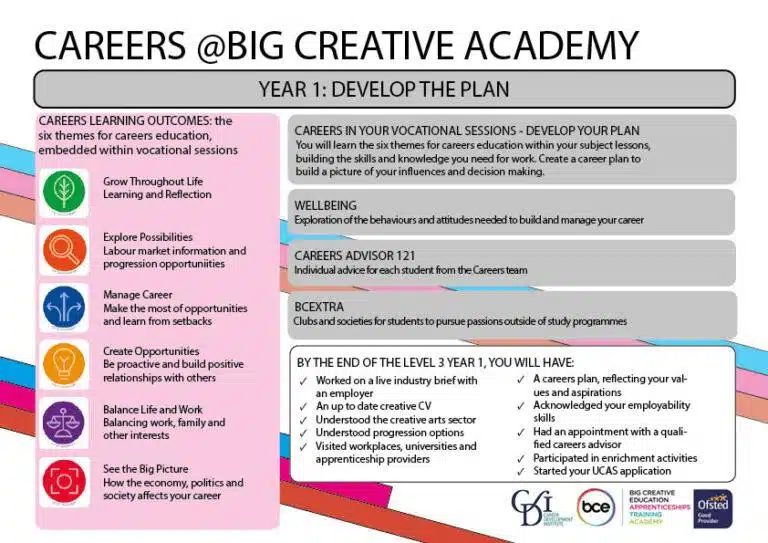
BCE Careers Programme
The careers education programme for our Level 3 courses is straightforward:
- Year 1 – Develop the Plan – understand progression options and develop your careers plan
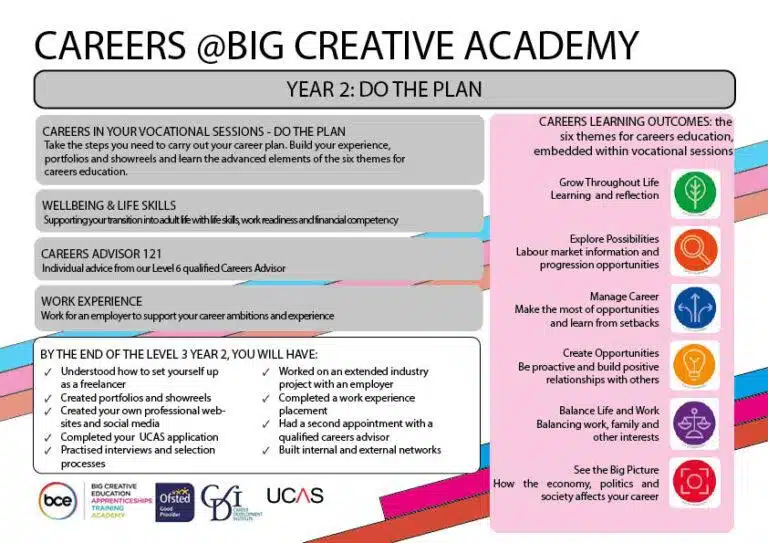
- Year 2 – Do the Plan – carry out your careers plan, building content and experience
Programmes and Policies
BCA Careers Programme 2026-27 (next review date August 2027)
BCT Careers Programme 2026-27 (next review date August 2027)
Careers Education, Information, Advice and Guidance Policy – September 2026
Work Experience Policy – September 2026
Provider Access Policy – September 2026
We offer talks for schools where you can either visit us, or for us to come to you. BCE is both a T Level and apprenticeship provider and we would be happy to arrange a tour and talk to comply with provider access requirements.
For queries and information please contact Big Creative Academy’s Careers Leader – Victoria Spence [email protected]
For Students
Careers education at college
Your careers education is woven throughout your experience at Big Creative Academy, and is based on the learning recommended by the Careers Development Institute. The main purpose of the CDI’s Career Development Framework is to clarify the skills, knowledge and attitudes that individuals need to have a positive career. A ‘positive career’ will mean something different to everyone, but it will typically include being happy with the way you spend your time, being able to make a contribution to your community and being able to have a decent standard of living.
The careers programme will help you kickstart your career in the creative arts and also help you recognise transferable skills you can take into other sectors.
What can I do after I finish my course?
Typically students follow one of three main pathways in the creative arts
- Higher education
- Apprenticeships
- Employment, including working as a freelancer
Please see the tabs for more information about each pathway.
University
Roughly half of our graduating students go on to higher education, as further study and experience is a good way of getting into the creative arts. Half again are the first in their family to do so.
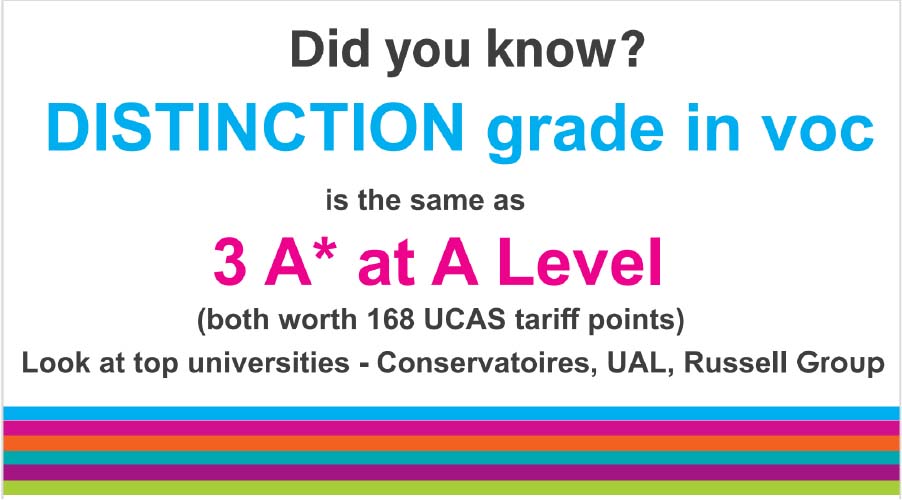
Big Creative Academy is very proud to support our young people getting into university and conservatoires. A distinction for a Level 3 course with us is worth 168 UCAS tariff points, equivalent to three A* at A Level. Our young people go onto the best universities, including Central St Martins, prestigious music conservatoires and drama schools.
How do I decide if I want to go to university?
It’s good to explore your reasons for further study:
- To expand your academic knowledge and gain experience
- To move away from home
- To have an amazing time for personal growth
It’s a big step and we encourage young people and parents to talk to each other about this. It’s a big financial commitment too, and you’ll want to make sure you have a good return on your investment. But it comes down to whether you want to spend the next three years reading books and writing essays.
All students at Big Creative Academy will complete a UCAS application, but it’s your choice whether you submit it.
Have a look at these websites for information
- UCAS https://www.ucas.com/ (there is a portal for parents as well)
- icould https://icould.com/stories/should-i-go-to-university/
- The Student Room https://www.thestudentroom.co.uk/university/advice/think-uni-isnt-for-you-heres-how-to-decide
- Access HE https://www.accesshe.ac.uk/ (includes parent information, and creative arts information)
Which university should I go to?
There are lots of different factors in choosing which university is right for you, and you need to start asking yourself some tough questions.
- Do I want to stay at home?
- Do I want to go to a different city?
- Do I want a campus university, or a city-based university?
- Do I want to study abroad?
- Are there only specific universities that do the course I want to do?
- Do I want to go to a Russell Group university, or conservatoire?
The Uni Guide is helpful to have a look at https://www.theuniguide.co.uk/advice/choosing-a-course/which-university-is-best-for-you
Universities are ranked, meaning that some universities are better than others. When applying for jobs employers will judge you based on which university you went to, so it’s important to go to the best university you can. The lists below give you more information and you can filter them by subject.
QS World University Rankings 2023 https://www.topuniversities.com/university-rankings/world-university-rankings/2023
Times Higher Education World University Rankings 2023 https://www.timeshighereducation.com/world-university-rankings/2023/world-ranking
The Complete University Guide https://www.thecompleteuniversityguide.co.uk/league-tables/rankings
The Guardian The best UK universities 2023 – rankings https://www.theguardian.com/education/ng-interactive/2022/sep/24/the-guardian-university-guide-2023-the-rankings
If you going to get a distinction for your Level 3 course, you should be looking at Russell Group universities and be amongst the best in your field. Have a look at this link to explain more about Russell Group universities:
https://successatschool.org/advicedetails/341/What-Are-the-Russell-Group-Universities%3F
What is a conservatoire?
Conservatoires are very prestigious, specialist training organisations for music, dance and drama. There are only eleven of them in the UK, and could be your fast track ticket into the creative arts. Their courses are like university courses but are more vocational, practical and professional.
UCAS Conservatoires https://www.ucas.com/conservatoires/studying-conservatoire/ucas-conservatoires-getting-started
FAQs on conservatoire training https://conservatoiresuk.ac.uk/conservatoires-explained/frequently-asked-questions/
UK drama schools you should know about https://www.backstage.com/uk/magazine/article/the-drama-schools-uk-actors-should-know-67213/
Student Finance
Applications for student finance usually start in March each year, for entry to university in September. Here’s the official website:
https://studentfinance.campaign.gov.uk/
Student finance is in two parts:
- Tuition fee loan – usually £9,250 and paid directly to your university
- Maintenance loan – means tested according to parental income, £8,171 to £13,022
This is per year, and university courses are normally three years, so you need to multiply these costs by three.
Here’s the full presentation on student finance
Other funding pots available at universities
Link to article on higher earnings for graduates https://careerresources.org.uk/graduates-are-more-likely-to-earn-more-than-non-graduates
Apprenticeships
Apprenticeships are a good way to earn with an employer whilst also training and expanding your experience. There are three elements to an apprenticeship:
- You, the apprentice
- The employer, who you work for
- The training provider, where you will study
You will spend 80% of your time doing the job, and 20% of your time at the training provider, studying your course.
Big Creative Training is an apprenticeship training provider and has links with lots of different companies for whom you can work. Here’s all the information:
http://bigcreative.education/apprenticeships/
Apprenticeships can be competitive, but often companies want young people with no experience they can work with for specific roles.
How do I find apprenticeships?
There are a number of different ways you can look for an apprenticeship:
- Through employers – identify a company you want to work and see if they have apprenticeships
- Through the training providers – go to apprenticeship training provider websites to look through the vacancies they have. See infographic on training providers by subject.
- Through the apprenticeship government website – lists of apprenticeships available and vacancies
- Through job search websites – indeed, reed, monster all list current apprenticeship opportunities if you type “apprenticeships” into the search
Higher level apprenticeships
For higher level apprenticeships, a university is the training provider and your tuition fees are paid for. There is no cost to you as the apprentice, and you earn as you would in a job whilst also studying for a degree.
Read the blog piece for more information: http://bigcreative.education/higher-apprenticeships-what-are-they/
Amazing Apprenticeships: Higher level and degree apprenticeships – listed in January each year https://amazingapprenticeships.com/resource/higher-and-degree-listing/
Employment
If you want to go straight into a job have all of your tools ready:
- A plain English CV
- A creative CV
- A portfolio
- A self tape or showreel
- Covering letter template
- Personal statement template
- Professional social media if required
You also need to know where to look for job opportunities:
- Job search websites: Indeed, Monster etc.
- Creative arts websites: see the infographic for job websites by course. Also see Create Jobs, ArtsJobs, The Dots, If You Could, Design Jobs Board, Run the Check, Creative Lives in Progress
- Job Agencies for the creative arts: Creative Access If you register with the agency they will call you when they have roles they think you will be suitable for.
Need a bit more help?
There are lots of employability short courses, schemes and programmes around to help young people into the creative arts. These are often organised by councils, charities and employers and we will update this section of our website when they become available.
Future Formed: https://www.walthamforest.gov.uk/jobs-and-training/find-jobs-and-other-opportunities/future-formed
Starting your own business and working for yourself
Many people within the creative arts work for themselves, and you’ll need to understand how you look for work yourself and pay your taxes.
For Employers
Our curriculum is industry-led and we work closely with employers to ensure we are teaching our young people the skills and knowledge they need for the world of work.
Students work with employers on industry briefs and extended projects, as well as employers kindly giving their time to talk to students about their expertise. We are very grateful for the goodwill extended to our young people.
See the employer brochure for all the ways employers can work with us.
We also have an employer advisory board to ensure we are preparing our students for jobs for the future, and we are members of Creative UK and Business LDN.
Blog piece http://bigcreative.education/big-creative-academy-partners-with-business-ldn/
For Tutors
Embedding careers into the curriculum
At Big Creative Education we embed careers into everything we do, ensuring students learn about the creative industries and sport throughout their time with us. Everything contributes to a student’s progression outcome, and we have high expectations for our students.
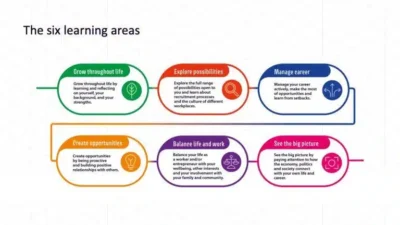
Learning objectives for careers are embedded into the curriculum, which are recommended by the Careers Development Institute. There are 35 in total grouped into six themes:
- Grow throughout life
- Explore possibilities
- Manage your career
- Create opportunities
- Balance life and work
- See the big picture
The 35 careers learning objectives are embedded into vocational and wellbeing classes, leading to good understanding for the learner of how to go about their decision making for careers, where to find information and feel confident about their next steps.
Embedding careers is a joint endeavour with the careers team supporting curriculum to ensure good quality careers learning. This may include the careers supporting curriculum by doing sessions for students themselves, or providing resources for tutors on specific topics. You might feel it best that a subject is best delivered by an external facilitator and the careers team will help tutors source contacts. It’s a collaborative process.
For more information please go to the Careers Manager in the first instance, Jyoti Farmah.
Further resources:
DfE Careers Guidance and Access for Education and Training Providers (2026)
Careers & Enterprise Company Gatsby Benchmark 4 Linking Curriculum to Careers